School Uniform Embroidery: Crests, Names & Bulk Orders Guide
School uniforms are one of the most demanding jobs in embroidery. A crest has to look identical on a six-year-old’s blazer and a teenager’s sweater, student names have to be spelled perfectly across hundreds of garments, and everything has to survive a school year of weekly washing. Getting it right starts with the digitizing — and with planning that most uniform suppliers only learn the hard way.
This guide covers how school crests are simplified for small sizes, where logos sit on blazers and sweaters, how name embroidery works, and how to plan bulk orders so nothing goes wrong in the back-to-school rush.
School Crests: Beautiful Artwork, Tricky Embroidery
Most school crests were designed for print and signage, not thread. They often contain shields, banners, motto scrolls, animals, and several lines of tiny text — all of which has to fit inside a patch of embroidery roughly 2.5 to 3.5 inches wide. Sewn exactly as drawn, the detail collapses into an unreadable knot.
A digitizer simplifies a crest for thread by:
- Removing or merging fine lines — thin outlines under about 1mm disappear or bleed into the fill next to them
- Dropping tiny motto text or enlarging it — lettering under roughly 4–5mm tall cannot hold its shape in thread; many schools approve a crest version without the smallest scroll text for uniform use
- Reducing color count — five shades of blue become two or three that still read correctly at a distance
- Boldening the main shapes — the shield, star, book, or animal that identifies the school gets priority so the crest is recognizable across a playground
Always sew a sample crest and get it approved before the bulk run. One approval sample is cheap; re-doing 300 blazers is not. For more on sizing chest logos in general, see our left chest logo size and placement guide.
Placement on Blazers, Sweaters, and Polos
Standard placement for school uniform embroidery:
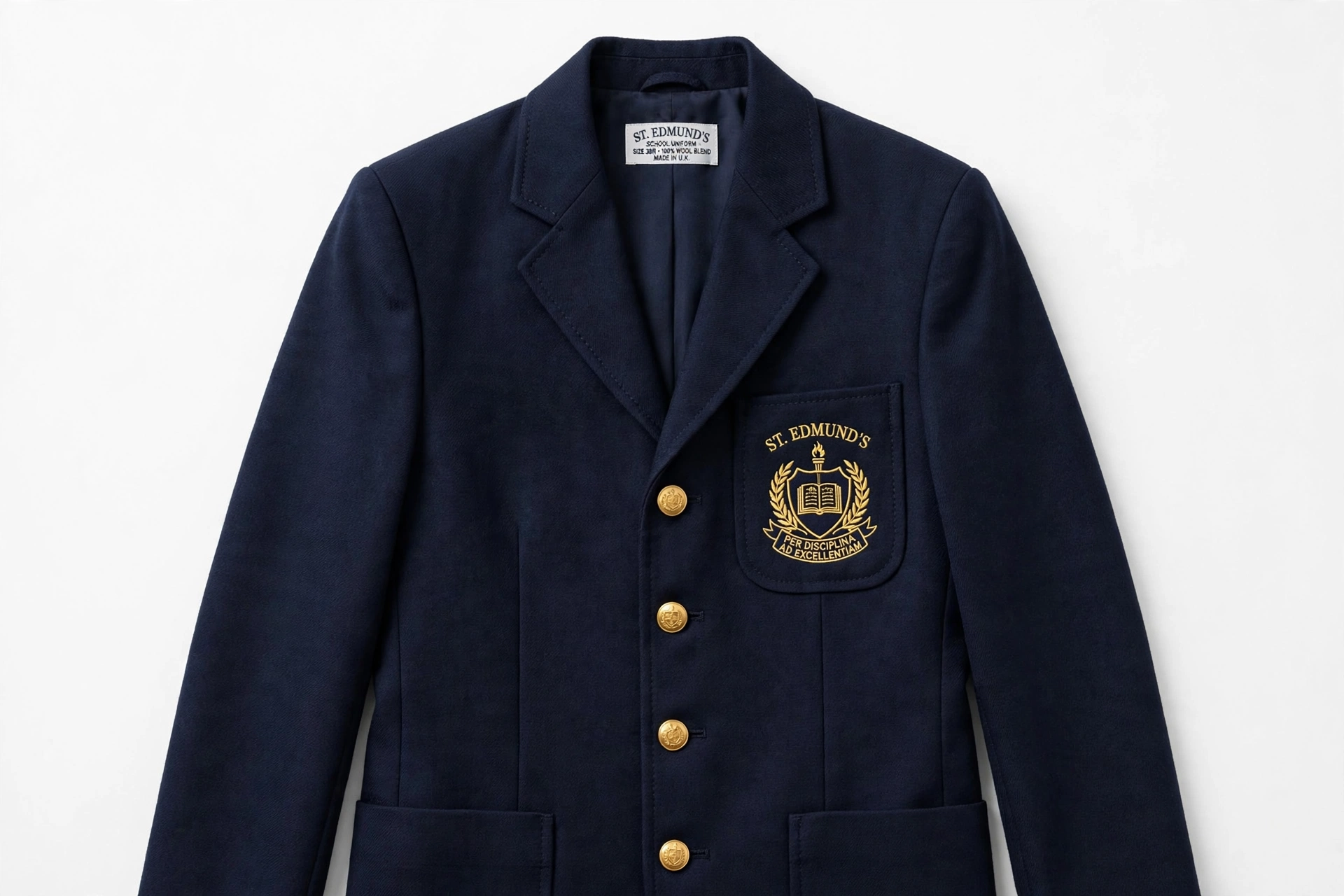
- Blazers: the crest sits on the left chest, centered on the pocket or just above it. Many blazers have the crest embroidered directly through the pocket area — the pocket is often decorative on uniform blazers, and stitching through it is normal practice unless the school says otherwise.
- Sweaters and jumpers: left chest, same height as the blazer crest so a student’s set matches. Knit fabrics stretch, so the file needs proper underlay and a cutaway stabilizer to stop the crest distorting.
- Polo shirts and PE kits: a smaller, simpler crest version or just the school name in a clean font — summer polos usually get a reduced-detail design because the piqué knit fabric shows detail poorly.
- Ties and accessories: rarely embroidered; woven or printed crests are more common. Don’t promise embroidery on items too small or stretchy to hold it.
Measure placement from the shoulder seam and center line, and write the measurements down. “Left chest, looks right” is not a spec when three different people are hooping garments.
Student Name Embroidery
Names are the second half of most uniform jobs — names on blazers, bags, PE kits, hats, and lunch carriers so lost property comes home. Common approaches:
- Name tapes — a name embroidered on a strip of fabric that is then sewn onto the garment; useful when names change or garments get handed down
- Direct name embroidery — name stitched straight onto the garment, usually in a simple block or script font at 0.4″ to 0.6″ tall
- Initials or house names — some schools use house colors and embroider the house name instead of, or with, the student’s name
Font choice matters: script looks lovely but block lettering reads better and sews cleaner at small sizes. Whatever the school chooses, digitize the name style once and reuse the template so every name matches.
The Bulk Order Problem: Name Lists and Accuracy
The embroidery is easy. The accuracy is the job. A typical school order arrives with a spreadsheet of 200 names in different sizes across different garments — and one misspelled name means one remade garment and one unhappy parent.
Practical rules that prevent errors:
- Work from one master list. Get the school or parents to confirm spellings in writing. Names you “fix” because they look wrong are how correct-but-unusual spellings get ruined.
- Batch by garment, then name. Sew all blazers of one size together so setup changes are minimal, checking each name against the list as it comes off the machine.
- Double-check similar names. Every list has an Aiden and an Aidan, a Sara and a Sarah. Slow down on those.
- Keep the files. Next term, siblings and new starters will need the same crest and name style — archived files turn a repeat order into a quick one.
Fabrics: Blazer Cloth, Knits, and Everything Between
School uniforms cover more fabric types than almost any other embroidery category. Blazer cloth is stable woven polyester or wool blend — friendly fabric. Sweaters are knits that stretch in the hoop. Polos are piqué knit with a textured surface that eats fine detail. PE shirts are often thin performance fabric that puckers if the design is too dense.
Each fabric wants slightly different density, underlay, and stabilizer. A crest file built for blazer cloth will often distort on a sweater. Tell your digitizer every garment type in the order — a good digitizer supplies adjusted versions of the same crest for woven and knit fabrics so the results match visually even though the files differ.
Some schools skip direct embroidery for the crest entirely and use embroidered patches sewn onto blazers — easier replacements and consistent results across garment types. If that route interests you, our custom embroidered patches guide covers sizes, borders, and backings.
Planning for Back-to-School Season
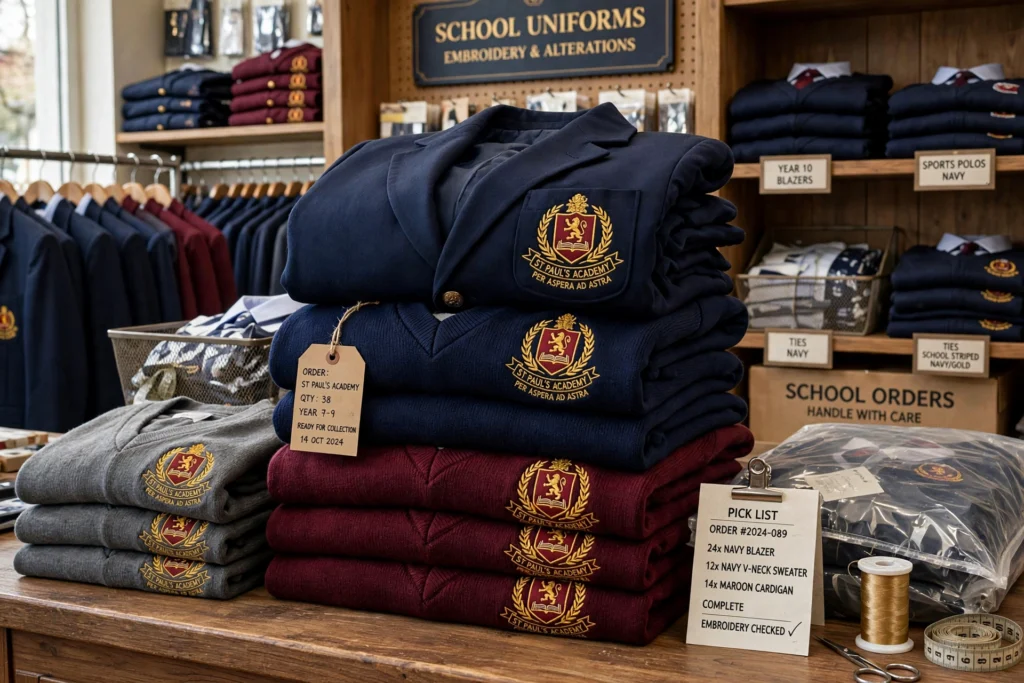
Uniform embroidery is brutally seasonal. Most of the year’s volume lands in the six weeks before term starts, and every school wants delivery in the same fortnight. Plan backwards:
- Crests digitized and approved early — get sample approval in the quiet months, not in August
- Names collected with a deadline — late name submissions are the number one cause of rushed, error-prone runs
- Garment stock checked — embroidery cannot start on blazers that haven’t arrived
- Buffer built in — machines break and garments get mis-hooped; a schedule with no slack has no mercy
If you supply uniforms and your digitizing is the bottleneck, outsourcing the crest and name files during peak season keeps machines sewing instead of waiting. Digitizing starts from $10 per design with 4 to 12 hour turnaround — fast enough to keep a queue moving even mid-rush.
Frequently Asked Questions About School Uniform Embroidery
What size should a school crest be on a blazer?
Most blazer crests finish between 2.5 and 3.5 inches wide. That is big enough to read the main shapes, small enough to sit properly on the chest. Very detailed crests sometimes go slightly larger with the school’s approval.
Can any school crest be embroidered?
Almost any crest can be adapted, but not every crest can be embroidered exactly as drawn. Tiny text, hair-thin lines, and gradients get simplified. A good digitizer shows you the adapted version for approval before sewing.
Where do student names go on uniforms?
Commonly on the right chest opposite the crest, on bags, or on name tapes sewn inside or outside the garment. Each school has its own policy — confirm placement and font before starting.
How do you avoid spelling mistakes in bulk name orders?
One confirmed master list, checked garment-by-garment as work comes off the machine, with extra care on similar names. Never retype names from memory or “correct” a spelling without asking.
Can the same crest file be used on blazers and sweaters?
The same artwork, yes — but the stitch file often needs adjusting between woven blazer cloth and stretchy knit sweaters (density, underlay, pull compensation) so the finished crests look the same.
Get Your School Crest Digitized From $10
A crest that sews cleanly at 3 inches, names that come out spelled right, and files ready before the rush — it all starts with proper digitizing. Order our embroidery digitizing service from just $10 at ndigitizing.com. Every file is 100% manually digitized, delivered within 4 to 12 hours, with free revisions until it sews perfectly on your uniforms.