
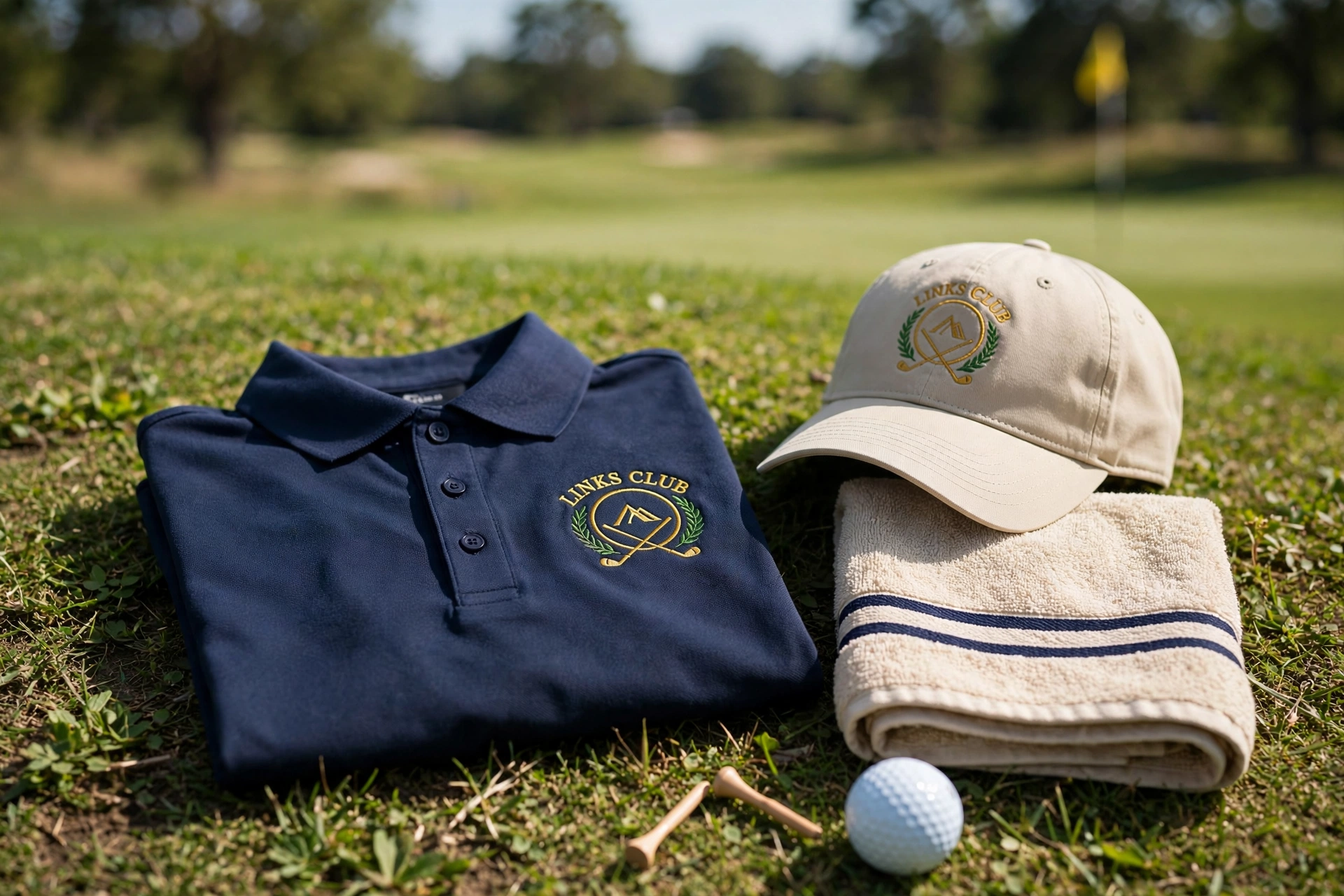
Golf Embroidery: The Most Brand-Conscious Corner of the Sport

No sport dresses like golf. Players wear logoed polos, carry embroidered bags, hang branded towels from their carts, and top it off with a cap — and almost every logo on the course is embroidered, not printed. That makes golf embroidery a steady, high-value niche for embroidery businesses and a branding essential for clubs, resorts, and corporate golf days.
The good news: golf items follow well-established placement and size standards, refined over decades by pro shops. This guide walks through each item — polos, towels, caps, and bags — plus the corporate tournament angle and the one factor golfers’ gear faces that most garments do not: the outdoors.
Polo Shirts: The Left Chest Standard
The golf polo is the most standardized embroidery job in the industry:
- Placement: left chest (wearer’s left), centered between the placket and the side seam, roughly 3 to 4 inches below the shoulder seam.
- Size: 3.5 to 4 inches wide is the classic range for club and corporate logos. Smaller reads cheap; larger looks like a billboard.
- Fabric note: polos are usually piqué knit or smooth performance polyester. Performance fabrics are slippery and stretchy, so the file needs proper underlay and the garment needs cutaway stabilizer — a logo that puckers on a polo fails in the most visible spot possible.
Club crests follow the same simplification rules as any detailed logo: fine text rings and tiny elements are enlarged or removed at chest size. If you are ordering polo logos for the first time, the full sizing and placement standards are covered in our left chest logo size and placement guide.
Sleeve logos are the popular second placement — a small flag, sponsor mark, or secondary logo on the left sleeve at about 2 to 2.5 inches. When a polo carries both chest and sleeve embroidery, digitize them as separate files sized for their own placements, not one file scaled twice.
Golf Towels: Working Around the Grommet
Every golf bag carries a towel, and the towel is prime branding space — it hangs outside the bag, visible all round. Standard practice:
- Placement: most golf towels have a grommet and clip in one corner. The design goes at the opposite end or centered on the display side, far enough from the grommet that the design hangs flat instead of bunching at the clip.
- Size: 3 to 4.5 inches wide suits the folded towel’s display area.
- Fabric reality: towels are terry cloth. Loops swallow stitches, so towel designs need a knockdown stitch layer underneath and bolder shapes than the same logo on a polo. A chest logo file cannot simply be reused on a towel — it must be re-digitized for terry.
The full towel technique — knockdown stitches, topping, and densities — is covered in our towel embroidery digitizing guide.
Personalized golf towels (name under a club logo, or a monogram) are also one of the strongest golf gift products, because the towel is the one item every golfer actually uses every round.
Caps: Small Designs, Center Stage
Caps complete the golf uniform, and cap embroidery has its own rules:
- Front design: maximum about 2.25 inches tall, centered on the front panels. Golf cap designs are usually the club mark, a simple icon, or short wordmark.
- Structured fronts need cap-specific digitizing: the file must be digitized center-out with adjustments for the curved, buckram-backed surface. A flat file sewn on a cap puckers at the edges and drifts off-center.
- Side and back placements: small flags, names, or tournament years at 1.5 to 2 inches — popular for event caps where the front carries the main logo.
Order cap files separately from flat files even when the artwork is identical. It is one of the most common and most avoidable causes of a bad sew-out.
Golf Bags and Accessories
The bag is the biggest canvas in golf: the large pocket panel takes designs 5 to 8 inches wide, often the owner’s name, club crest, or both. Bag panels are usually heavy synthetic material — stable and embroidery-friendly, but thick, so sharp needles and firm hooping (or removing the pocket panel where the bag allows it) matter more than special digitizing.
Accessories round out the set: headcovers with numbers or initials (knit headcovers need stretch-aware digitizing similar to socks — bold, simple marks), shoe bags, valuables pouches, and umbrella panels for clubs that brand everything. A matched set — same crest across polo, towel, cap, and bag — is exactly what premium clubs and resorts order, and the crest should be digitized per item, each sized and adjusted for its surface.
Corporate Golf Days: Where the Volume Is
The biggest golf embroidery orders rarely come from individual golfers. They come from corporate golf days, charity tournaments, and sponsored outings, where one logo goes on everything: polos for players, caps, towels as tee gifts, and sometimes bags for prizes.
Tips for handling (or ordering) tournament work:
- One logo, four digitizing jobs. Polo chest, cap front, towel, and sleeve each need their own properly sized file. Budget and timeline should count them separately.
- Sponsor hierarchy. The event logo usually takes the polo chest; sponsors go on sleeves and towel. Agree placements before digitizing, not after sewing.
- Rush reality. Tournament orders are famously last-minute. Digitizing files can be turned around in 4 to 12 hours, but sewing 150 polos cannot — the earlier the files are ready, the calmer the sewing week.
- Consistent thread colors across items make the set look professional in photos, which is half the point of a branded golf day.
Thread That Survives the Outdoors
Golf gear lives outside: sun, rain, sweat, and frequent washing. Thread choice is part of the embroidery job, not an afterthought:
- Polyester thread is the standard for golf. It resists UV fading and chlorine/bleach far better than rayon, which looks richer indoors but fades and weakens with sun and washing.
- Colorfastness shows most on dark caps and towels, which bake in the sun on a cart for five hours a round.
- Digitizing cannot fix thread choice, but it can help: solid fills and slightly higher density hold color visually better outdoors than sparse stitching.
If you are ordering files for golf gear, tell the digitizer the items will live outdoors — it is one more reason we may simplify fine detail that weather and washing would blur anyway.
Frequently Asked Questions About Golf Embroidery
What size should a logo be on a golf polo?
The industry standard is 3.5 to 4 inches wide on the left chest, centered between the placket and side seam. Sleeve logos run smaller, around 2 to 2.5 inches.
Can the same file be used for a polo, cap, and towel?
No — each surface needs its own file. Caps need center-out cap digitizing at 2.25 inches tall maximum, towels need knockdown stitching for terry loops, and polos need sizing for the chest. One artwork, several purpose-built files.
Where does embroidery go on a golf towel?
On the display area away from the grommet corner, so the design hangs flat. Sizes of 3 to 4.5 inches work well, and the design must be digitized for terry cloth with a knockdown layer.
What thread is best for golf apparel?
Polyester embroidery thread. It withstands UV exposure, sweat, and repeated washing far better than rayon, which matters for gear that spends hours in the sun.
How much does it cost to digitize a golf set?
Each file starts from $10 with our service — a polo chest logo, cap file, and towel file are separate digitizing jobs, each delivered within 4 to 12 hours with free revisions included.
Digitize Your Golf Logos From $10 Per File
Whether it is one club crest sized correctly for chest, cap, and towel, or a full corporate tournament set, the files have to be built for each surface they will sew on. Order our embroidery digitizing service from just $10 at ndigitizing.com. Every file is 100% manually digitized for its exact garment — polo knit, cap curve, or terry towel — delivered within 4 to 12 hours with free revisions until the whole set sews perfectly.